Wednesday, February 22, 2017

rocket A launch!!!!


A lovely photo from NASA photographer Terry Zaperach.

A lovely launch into a spectacular substorm, a perfect trajectory

A perfect call from a truly superior science team.

We think that the Bobs did not deploy so we will be assessing that tomorrow;  looks like all the other instrumentation worked fine.  Good Efield data from the Cowboy, and ERPA and MainPIP data.  Dave H, we launched into a nice eastward flow region for you!

More news tomorrow.

Tuesday, February 21, 2017

not yet

Two moose and some hair-raising driving and some pretty aurora, but no launch(es) yet.  We have great hopes for tomorrow night as the weather should clear for a bit before a big storm.   -25F at the bottom of the hill tonight.
I always forget, until I see them again, how /big/ moose are.
We have swapped out one team member from the Venetie station;  I'll ask him tomorrow for some pictures from his time up there this past week, and post them here.

Monday, February 20, 2017

quiet, short, cloudy night

A short night tonight, with pretty solid cloud cover over Venetie for all of the evening.  The other mission took the opportunity to resolve a few technical issues, and we all left an hour early, a welcome respite after staying 2 extra hours (until 3am) 2 days ago, and 1 extra (until 2am) yesterday.

The composite imagery put together by the UAF group is now posted publicly at  http://sdi_server.gi.alaska.edu/sdi_web_plots/alaska_merged_data_maps/mapped_allky_images.htm
at the moment it's pretty cloudy across Alaska but when the skies are clear and the aurora is active, it shows beautiful images of the auroral oval stretching across Alaska.

We spent much time this evening discussing the magnetometer traces that you can see at
https://www.asf.alaska.edu/magnetometer/liveplot/
If you choose Kaktovik, Toolik, Ft Yukon, Poker, and Eagle;  24 (or 6)  hours, 250 nT in the right hand column, you will see the display that we mostly use.  This shows the magnetic signatures as a function of latitude (Kaktovik is on the North Coast, down to Poker where we are, and Eagle a bit to the east).  The auroral activity is accompanied by horizontal currents.  A current is accompanied by a magnetic signature.  So this gives us a metric for the intensity of the aurora.  In the evening sector (during our window) the electrojet is predominantly westward.  A westward current over your head would be measured as a southward magnetic deflection on the ground (remember Ampere's law from your E&M course;  put your thumb along the current and your fingers wrap the magnetic field), so we are looking for the horizontal (H, red) trace to have sudden excursions downward.  We'd really like those to be a few hundred nT, for perhaps 10-20 minutes.  What we've seen in the last few days have been smaller, periodic "blippies" as we have been calling them.

We'll be hoping for some clear skies in the next few days as a large snowstorm is bearing down on us later in the week.

Sunday, February 19, 2017

not yet...

Another relatively active night with clear skies at Venetie and clouds at Poker, so we were prime again waiting for an event we could use.  The solar wind has been strong for the past few days, but during our window time, it has not coupled well into the Earth's environment, instead sliding on by without giving a lot of energy to the auroral zones.  We have had aurora in the north, but it has not been powered by the strong current systems we are trying to study.  This also makes the aurora rather "flash-in-the-pan", with lots of sporadic bursts of activity that don't hang around.  Thus we dropped the count three times tonight, trying to catch one of them, but none of them developed into a useful event.
    The solar wind should drop off a bit in the next few days, but that's ok as we don't need or want too much activity (in which case the aurora would move too far south for us);  we just need better coupling of a moderate solar wind into the Earth's environment.  Predictions are for better weather at Poker tomorrow night, so it may be that we stand back to give the other mission an opportunity to try for a launch.  We'll see how it goes.
   Rob has posted a short tutorial about how we interpret the data we are watching, to decide about launching the rocket;  it's on the "Useful Links" page of this blog.  I'll try to update it in the next day or so to include a description of the auroral current signatures we are looking for for Isinglass.
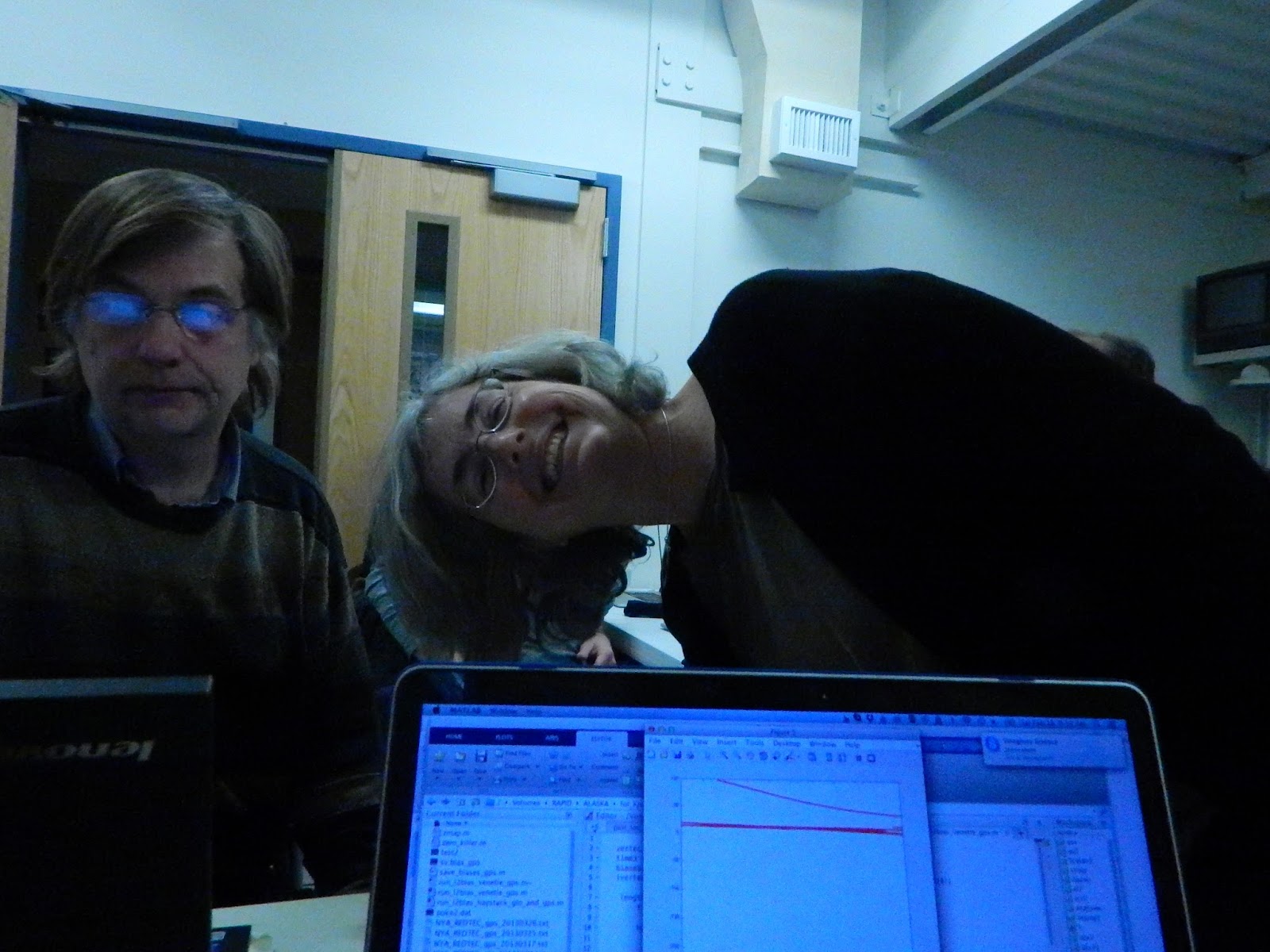
   We took a picture of our science team tonight, just before Anthea had to leave;  I'll post it here.


Saturday, February 18, 2017

tenterhooks but no launch.....

we spent a lot of tonight at a 3 minute hold, but the stars never aligned so no launch yet.

scientists at work:


and a beautiful composite display from Mark Conde and Don Hampton:


Friday, February 17, 2017

a lovely night but no launch yet

We had an excellent night, with lots of lovely aurora and two healthy rockets.  We started the night with some additional turnon checks to verify a slightly different turnon procedure, which seems to mitigate some instrumentation kerfuffle we were dealing with last night.  That worked nicely, and our vertical checks (a practice run through the countdown procedure which we do every night before the window opens;  the rocket is vertical, thus the name) went smoothly.  The other mission is "prime" early in our shared window (they get dibs 7-10 pm and we have control 10-1 am), so we had some good science discussion among our group in the early part of the evening.
     We have a (large) number of cameras installed in a small village called Venetie, north of the range.  These cameras will take movies of the aurora at different wavelengths and with different fields of view, throughout the window and in particular during the flight.  A major part of this mission will be the assimilation of these groundbased observations (plus from the various radars) with our observations from onboard the rocket(s).  Thus, if it is cloudy at Venetie, we can't launch, as those cameras can't see.  So tonight, we had clear skies at Poker, but it was cloudy at our downrange site at Venetie.  So while we could watch the aurora, we couldn't launch.  So we had a good time watching the aurora and running a few "practices" where we (the science team) decide when is a good time to "drop the count", and see if we get it right.  (We are sitting at a 10 minute hold throughout the night, which means that at any time, if conditions are right, we can launch within 10 minutes;  when we drop the count, it means we bring things to a 3 minute point, from which we can either launch within 5-10 minutes, or recycle back to 10.)
   So all in all a good night;  we hope for a repeat tomorrow of the healthy rockets and the good aurora, but without the downrange clouds.
   Here are some pictures of the aurora that Anthea took from outside the science building:


and here is a picture of the Lidar facility (an instrument which looks at the mesosphere by scattering a  laser off neutral metal atoms in the upper atmosphere, PI Prof Rich Collins UAF/GI)


Thursday, February 16, 2017

Some range and moose pictures!

No launches yet, some pictures from the range.

 Baby moose on the way home!  Mommy moose ran off before we could take a picture.

Rockets on the rail!  Kept nice and warm in their heated boxes. 

Telemetry station and dishes!

View from the TM building on the hill, including PFISR on the lower right.